Company
Meet Crew
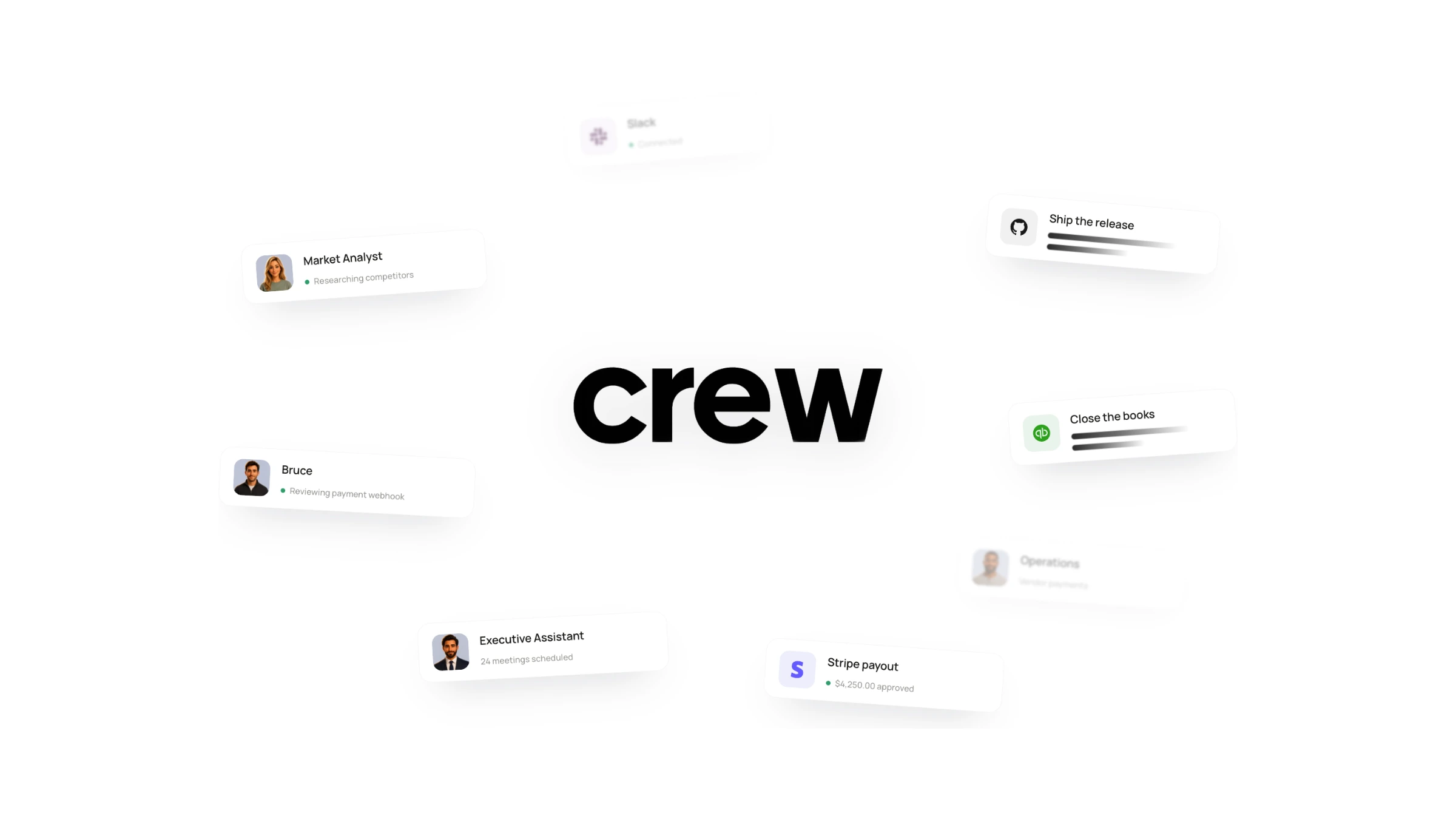
Crew is a platform for hiring and running AI employees inside your company. They come trained for real roles, learn how your business works, take responsibility for ongoing work, and operate inside a company structure built for them to actually contribute.
Ariel Kopolovitz6 min read
Most companies are beginning to use AI by adding it to the tools they already have. A model writes inside the editor, summarizes a meeting, drafts an email, answers a question, or helps someone move through a task faster. That is already useful, and it will keep getting better.
But it is still mostly software waiting for a person to decide when the work begins.
Crew starts from a different idea.
We think companies will eventually have AI employees working inside the organization alongside the people already there. Not as one giant system running the business, and not as a collection of blank agents somebody has to assemble from scratch. They should arrive with a role, a way of working, and a set of responsibilities they are already trained to understand.
That is what Crew is built around.
You can hire employees from a workforce of trained roles across the functions a company already depends on. If the exact role you need does not exist, Crew can generate one from the same playbook and adapt it to the job you have in mind. From there, the employee learns the company it is joining: what the business knows, how work is organized, which systems matter, what it is responsible for, and where its authority stops.
The point is not to give companies more AI to manage.
It is to give them more capacity.
A workforce, not a collection of agents
The way you begin with Crew is deliberately simple.
You hire an employee.
That distinction matters because it changes the starting point. A blank agent asks you to define what it is, what it should do, how it should behave, and which tools it needs before it becomes useful. Crew starts further ahead. The employee already has a role and has been trained around the kind of work that belongs to it.
A sales employee should understand the shape of sales work before joining your company. An operations employee should already know how to think about ongoing processes, exceptions, ownership, and follow-through. The company should not have to invent the idea of the role every time it wants to add capability.
What Crew adds is the company around that training.
The employee learns how your business works. Its knowledge becomes specific to the organization. Its responsibilities become tied to real work. The systems it uses become the ones your company already depends on. Over time, the employee stops feeling like a model that knows a job in the abstract and starts behaving more like something that understands where that job fits inside the business.
That is also why departments matter in Crew. A workforce should not become a flat list of AI systems with different names. Companies have structure because structure makes responsibility legible. An employee belongs somewhere. Its work connects to other work. People need to understand who owns what and where something should go when the boundaries between roles begin to matter.
Crew is designed around that kind of organization from the beginning.
The work can live inside Crew
One of the most important things we realized while building Crew is that an AI employee needs somewhere for its work to exist.
Connecting AI to outside tools is useful, but it cannot be the whole story. If every meaningful thing an employee does has to live somewhere else, Crew becomes another layer sitting on top of the company rather than a place where part of the company can actually operate.
So employees can build and maintain workspaces inside Crew.
A workspace is not just a document or a chat. It can become the operating surface for whatever the employee is responsible for. A sales employee might maintain a pipeline that behaves like a lightweight CRM, with accounts, stages, notes, activity, and the current state of each opportunity. Another employee might build a dashboard that keeps an important part of the business visible. A research project can have its own structure and evolve as the employee learns more instead of disappearing into a series of conversations.
The shape of the workspace depends on the work.
That matters because not everything deserves another external tool.
Sometimes the company already has the right system and the employee should work there. Crew is built to connect to the tools companies already use, so work can continue where it already belongs. But sometimes the missing thing is not an integration. It is a small internal system that nobody ever had the time or reason to build.
An AI employee should be able to create that too.
That opens a much larger set of possibilities than simply asking AI to operate existing software. The employee can work in the company's tools when those tools are right, and create structure inside Crew when the work needs somewhere new to live.
Over time, a company can end up with an operating layer that reflects the way it actually works rather than forcing every new responsibility into another SaaS product.
That is one of the possibilities we find most interesting about Crew.
Work should keep moving
The value of an employee is not that they can do something impressive once.
It is that the company can rely on them to keep carrying something after the first interaction ends.
Crew is built around that continuity.
Employees can work toward projects and goals instead of only responding to isolated requests. A responsibility can remain active as the surrounding work changes. Progress can accumulate. Decisions can affect what happens next.
Schedules make some of that work predictable. An employee can be responsible for something that needs to happen every morning, every week, or at another regular interval without someone remembering to restart the process each time.
Triggers take that idea further.
A company does not operate only on calendars. Things happen. A customer replies. A payment changes. A new order arrives. A piece of work is completed. A number moves somewhere it should not. Eventually, an AI employee should be able to wake up because something relevant to its responsibility happened, understand why that event matters, and decide what work needs to follow from it.
That is very different from traditional automation.
A workflow says that when one event happens, a predefined sequence should run.
A responsibility is broader. The same event may mean different things depending on the state of the company, what has already happened, and what the employee is trying to accomplish.
We think that difference becomes important as AI gets better.
The goal is not for companies to build increasingly complicated webs of automations. It is for them to be able to say, in effect, this is yours, and have the surrounding system make that ownership real.
People still direct the company
None of this works if adding more capability means giving up control.
Crew is built around the idea that responsibility and authority are not the same thing.
An employee may own a piece of work without having unlimited permission to act. Some decisions should happen freely because stopping for approval would make the system useless. Others should come back to a person because the consequence matters.
The point is not to keep a human attached to every step. It is to keep people in control of the decisions that actually deserve them.
That is why Crew has approvals, permissions, activity, and boundaries around what employees can do. The more capable the workforce becomes, the more important those controls become too.
We do not think the future company is one where the humans disappear and the software runs everything.
We think the more interesting future is one where people can direct far more than they could personally execute.
A founder can keep more parts of the company alive without immediately building a much larger organization. A team can pursue work that used to sit untouched because nobody had enough capacity to own it. A specialist can have more leverage without spending most of the week maintaining the machinery around their actual judgment.
That is the meaning behind Crew.
AI should expand what a company is capable of without reducing the role of the people deciding what the company should become.
We are still early, and we expect the product to change considerably as real companies begin using it in ways we have not anticipated. That is part of why early access is direct. We want to see what people actually hand to an AI employee when the product stops being a demo and becomes part of how their company works.
The long-term idea is simple to say, even if building it is not.
Software gave companies tools.
We think AI can give them a workforce.
That is Crew.